Practical Deployment For Busy Eye Clinics
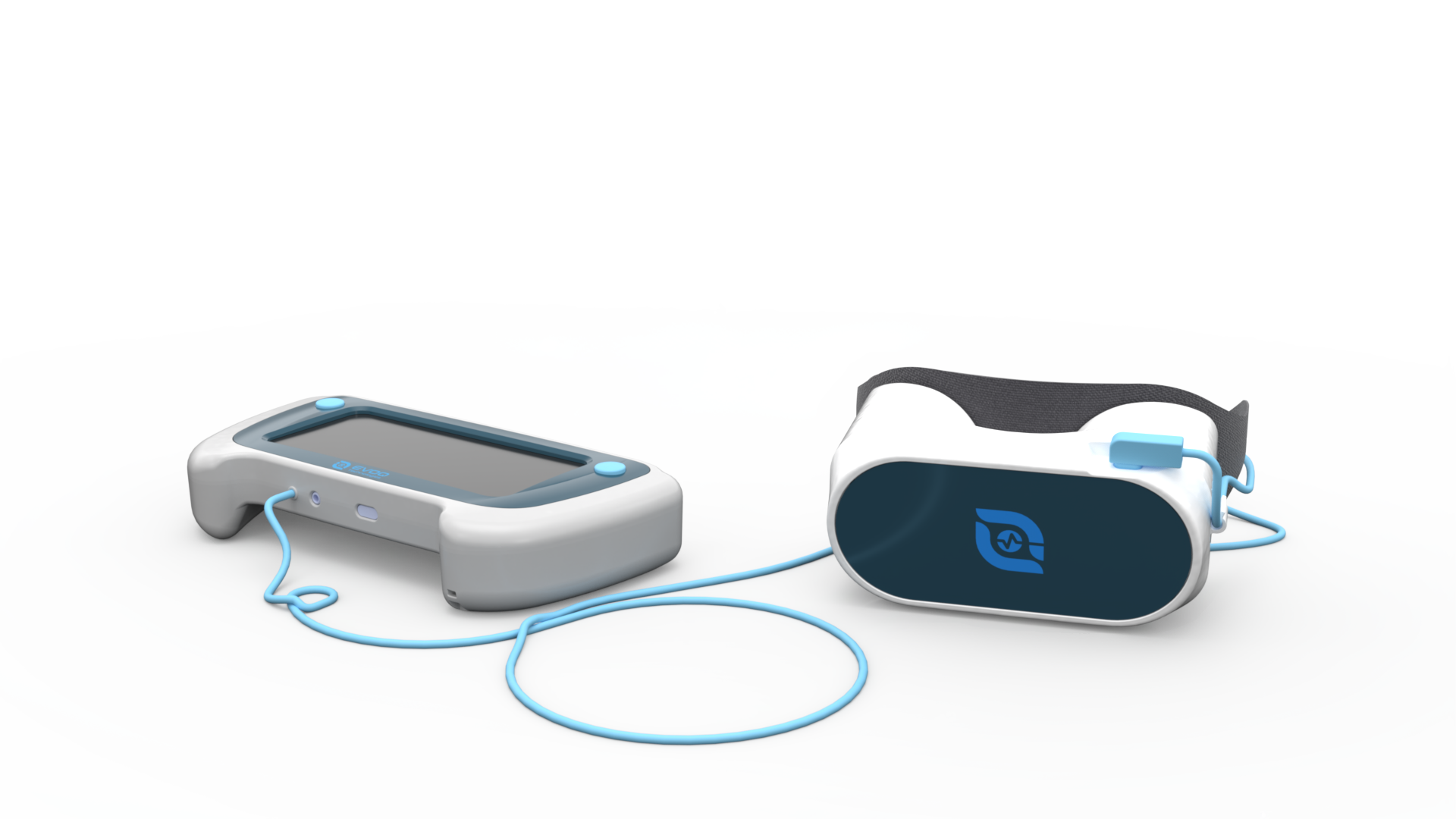
The Twilight™ Dark Adaptometer eliminates barriers to adoption, such as dark rooms, need for dilation, lengthy exams or heavy headsets, making dark adaptation testing practical for any primary eye care practice.
The device utilizes the 3LRI Protocol™, a proprietary method that measures rod-mediated dark adaptation in 6.5 minutes or less of active testing.
The clinical workflow is designed to be simple and technician-light:
- No Dark Room Required: The specialized eye mask handles ambient light, eliminating the need for a dedicated dark room.
- No Dilation: Patients undergo the exam comfortably without undergoing dilation.
- Audio-Guided Testing: The device guides the patient through the test with clear voice prompts, reducing staff supervision time.
- Intuitive Response: Patients respond using a simple two-button handset featuring a haptic click.
- Photostimulus Verification: An integrated photodiode to verify completeness of the dark environment and record any light leakage during tests.
- Support for Medical Billing:The built-in Medical Necessity Survey helps staff identify qualifying symptoms and medical history during intake, automatically documenting the clinical necessity of the diagnostic or screening exam.
Cloud-Connected and AI-Ready
Every dark adaptation recovery curve is captured continuously and uploaded automatically to SightGard™, EVOQ's HIPAA-compliant cloud analytics platform.
Rather than capturing only point-of-time data, SightGard™ structures the recovery curve and derives key metrics, including the 3LRI crossing (the time it takes the retina to recover 3.0 log units). The platform stores these measurements to build a secure longitudinal record for each patient. As the patient returns for follow-up testing, clinicians can easily compare new results against their historical baseline to monitor changes in retinal function over time.
Built with the future of functional diagnostic medicine in mind, the cloud-native SightGard™ data layer is fully AI-ready, structured to support future advanced analytics and predictive modeling.
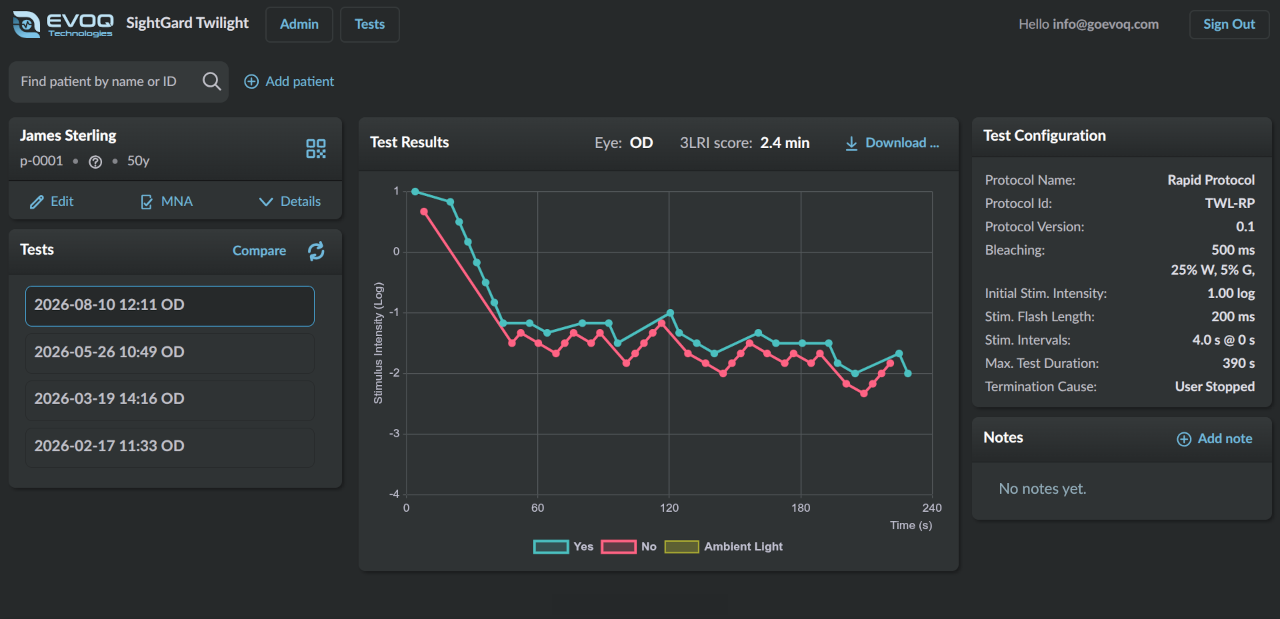
In the Rapid protocol, recovery that does not reach the 3LRI within 6.5 minutes is identified as abnormal. Results should be interpreted together with the patient's symptoms, history, risk factors, clinical examination, and other diagnostic findings.
Follow the five-step workflow built for seamless delegation to practice technicians.
Prepare
Enter or confirm patient information, select the eye and protocol, and position the light-blocking eye mask.
Medical Necessity Survey
Patient to respond to questions that help to establish if their test may qualify for reimbursement.
Photobleach
Twilight delivers a controlled stimulus while an integrated photodiode monitors exposure to verify integrity.
Measure Recovery
The patient uses a two-button handset to indicate whether each stimulus is seen. Audio prompts and haptic feedback guide the patient.
Review and Follow
The test curve, recovery metrics, and test results are securely transferred to SightGard™ Cloud for review.
Select Between Two Protocols
Rapid Protocol
Designed for efficient clinical assessment of recovery to the 3LRI criterion, with a maximum duration of 6.5 minutes after photobleaching. This protocol gives an answer to the question if dark adaptation is normal or abnormal (delayed).
Extended Monitoring
Continues the recovery curve for up to 15 minutes when the rapid test is abnormal and a doctor needs to know how much the dark adaptation is delayed.
Technical Overview
- Modality
- Dark-adaptation and retinal sensitivity-recovery assessment
- Test Format
- Monocular, psychophysical test
- Workflow
- Portable clinical system; no dedicated dark room required
- Patient Response
- Two-button Yes/No handheld controller with haptic feedback
- Control Interface
- Android clinical console with audio-guided prompts
- Results Output
- Test results, adaptation curve, 3LRI, curve analysis, photodiode light leakage monitoring
- Protocols
- Rapid (max 6.5 min) and extended monitoring (max 15 min) options
- Connectivity
- SightGard™ Cloud integration
- Longitudinal Results Review
- Available for authorized users through SightGard™
- Patient Interface
- Single-use light-blocking eye mask
Five Patient Types Can Benefit From Dark Adaptation Test
- Adults 50 years of age and older
- Patients with family history or early signs of AMD
- Patients with diabetes, even without visible retinopathy
- Patients reporting night vision or low light difficulties
- Patients on chronic medications with known retinal toxicity
Twilight does not replace the comprehensive eye examination or structural imaging. It adds a different dimension: an objective measurement of retinal recovery under low-light conditions.
Adults 50 years of age and older
Patients with family history or early signs of AMD
Patients with diabetes, even without visible retinopathy
Patients reporting night vision or low light difficulties
Patients on chronic medications with known retinal toxicity
New Revenue Stream For Eye Clinics
The diagnostic dark adaptation examination with interpretation and report is reimbursable under CPT® 92284. Coverage policies vary by payor, so each practice must check the reimbursement levels and limitations with their respective Medicare Administrative Contractors (MACs) and private insurers.
The screening dark adaptation examination with interpretation and report falls under the CPT® 92288, and is not reimbursed by Medicare. However, some private payors reimburse it. Practices are responsible for verifying the requirements.
To support practice billing compliance, the on-device Medical Necessity Survey walks the patient through standard medical history questions. This survey automatically establishes the clinical necessity of the test for the medical record, lowering the risk of claim rejection.
Most primary eye care practices do not currently offer dark adaptation testing, meaning the vast majority of symptomatic patients over age fifty go untested. Adopting the Twilight™ Dark Adaptometer allows a clinic to fill an important gap in patient care while establishing an immediate revenue stream.
The financial model is structured for rapid practice payback:
- Accessible Price: The Twilight™ standard system price is $9,799, plus the price of cloud subscription and eye masks.
- Reimbursement: Diagnostic dark adaptation testing under CPT® 92284 reimburses between $27 to $105 per exam for a qualifying patient, varying based on region and payer policies.
- Under One Year ROI at Two Tests on Average Per Day:Practices can fully recover their capital equipment and operating costs in less than twelve months, at two tests on average per day.
An interactive ROI Calculator is available to run practice-specific inputs and model your exact ROI based on your patient population.
Protect Your Patients' Vision and Your Practice's Future
Learn what a dark adaptation test can reveal for your patients and explore how Twilight™ fits into your clinical workflow.
Request a Live Walkthrough:Schedule a video call with our team for a live demonstration of the Twilight™ device and the SightGard™ cloud platform. You will see the SightGard™ dashboard in action and we will walk you through the structure of dark adaptation curves and how longitudinal comparative reports are generated.
Request a Sample Patient Report:Request a copy of an anonymized patient report. See exactly how the 3LRI slope metrics are presented for easy clinical review.
Model Your Practice's ROI: Run the ROI Calculator using your clinic's specific patient population to see how you can achieve a payback in under one year.